
In the ever-evolving world of technology, where innovation and competition drive the industry forward, the recent exchange between Elon Musk and Sam Altman has sent ripples across the tech landscape. The news of Elon Musk’s $97.4B OpenAI Bid to acquire OpenAI, followed by Altman’s witty rejection and counteroffer to buy Twitter, has sparked a flurry of speculation. Is this the beginning of a new war of technology? What does this mean for the future of AI, social media, and the broader tech ecosystem? Let’s dive deep into the implications of this high-stakes drama and what it signals for the future of technology.
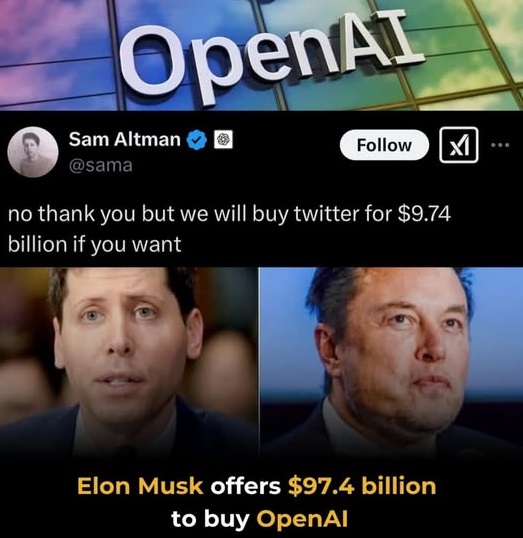
Table of Contents
The Backstory: Elon Musk’s $97.4B OpenAI Bid and Altman’s Twitter Jab
Elon Musk, the billionaire entrepreneur behind Tesla, SpaceX, and X (formerly Twitter), co-founded OpenAI in 2015 with the vision of creating artificial general intelligence (AGI) that benefits humanity. However, Musk has been critical of OpenAI’s direction in recent years, particularly after the organization transitioned to a for-profit model. His $97.4 billion bid to acquire OpenAI was seen as an attempt to regain control and steer the company back to its original mission.
Sam Altman, the CEO of OpenAI, declined the offer with a cheeky response on X: *“No thank you, but we will buy Twitter for 9.74billionifyouwant.”∗ThisstatementnotonlyrejectedMusk’sbidbutalsosubtlyreferencedMusk’s9.74billionifyouwant.”∗ThisstatementnotonlyrejectedMusk’sbidbutalsosubtlyreferencedMusk’s44 billion acquisition of Twitter in 2022, which has been a contentious topic in the tech world.
Meanwhile, former President Donald Trump announced a 500billionAIinvestmentinitiativeinvolvingOpenAI,Oracle,andSoftBank,whichMuskdismissedasunrealistic.Amidstallthis,OpenAIisreportedlyeyeingastaggering500billionAIinvestmentinitiativeinvolvingOpenAI,Oracle,andSoftBank,whichMuskdismissedasunrealistic.Amidstallthis,OpenAIisreportedlyeyeingastaggering340 billion valuation, positioning itself as one of the most valuable private companies in the world.
The Implications for Top-Ranked Technology Companies
The exchange between Musk and Altman is more than just a war of words—it’s a reflection of the growing tensions and competition in the tech industry. Here’s how this could impact the top-ranked technology companies:
1. OpenAI’s Rising Dominance in AI
OpenAI’s potential $340 billion valuation underscores its position as a leader in the AI space. With groundbreaking products like ChatGPT and DALL-E, OpenAI has revolutionized how businesses and consumers interact with AI. Musk’s bid to acquire the company highlights the immense value and strategic importance of AI in the future of technology. However, Altman’s rejection signals OpenAI’s commitment to independence and its ambition to remain at the forefront of AI innovation.
2. Elon Musk’s Expanding Tech Empire
Musk’s interest in acquiring OpenAI reflects his desire to consolidate his influence over key technological domains, from electric vehicles (Tesla) and space exploration (SpaceX) to social media (X) and AI. While his bid was unsuccessful, it’s clear that Musk sees AI as a critical component of his tech empire. His dismissal of Trump’s $500 billion AI initiative further emphasizes his focus on maintaining control over the direction of AI development.
3. The Battle for Social Media Supremacy
Altman’s quip about buying Twitter adds another layer to this saga. While it was likely made in jest, it highlights the ongoing challenges Musk faces with X. Since acquiring Twitter, Musk has faced criticism over his management style, platform changes, and declining user engagement. If OpenAI were to enter the social media space, it could disrupt the industry and challenge Musk’s dominance.
4. The Role of Other Tech Giants
The involvement of companies like Oracle and SoftBank in Trump’s $500 billion AI initiative suggests that other tech giants are also vying for a piece of the AI pie. This could lead to increased competition and collaboration among top-ranked companies, as they seek to leverage AI for strategic advantage.
Is This the Start of a Technology War?
The exchange between Musk and Altman has fueled speculation about a brewing “war of technology.” While it’s too early to declare an all-out war, there are clear signs of heightened competition in the tech industry. Here’s why:
- AI as the New Battleground: AI is rapidly becoming the most valuable and transformative technology, with applications across industries. The race to develop advanced AI systems is intensifying, and companies like OpenAI, Tesla, Google, and Microsoft are at the forefront.
- Clash of Visions: Musk and Altman represent two different visions for the future of AI. Musk advocates for cautious development to avoid existential risks, while Altman is focused on rapid innovation and commercialization. This clash of philosophies could lead to further conflicts and rivalries.
- Economic and Geopolitical Implications: As AI becomes more powerful, its economic and geopolitical implications grow. Governments and corporations are investing heavily in AI to gain a competitive edge, which could lead to tensions and rivalries on a global scale.
The Future of Technology: What’s Next for Musk and Altman?
The future of technology is being shaped by the actions and decisions of billionaires like Musk and Altman. Here’s what we can expect:
1. AI-Driven Innovation
AI will continue to drive innovation across industries, from healthcare and education to entertainment and finance. OpenAI’s advancements in natural language processing and generative AI are just the beginning. As AI becomes more sophisticated, its impact on society will grow exponentially.
2. Consolidation and Competition
The tech industry is likely to see increased consolidation as companies seek to acquire cutting-edge technologies and talent. At the same time, competition will intensify, leading to faster innovation and better products for consumers.
3. Ethical and Regulatory Challenges
As AI becomes more powerful, ethical and regulatory challenges will come to the forefront. Issues like data privacy, algorithmic bias, and the potential for AI to disrupt jobs will need to be addressed. Musk and Altman will play key roles in shaping the ethical framework for AI development.
4. Collaboration and Rivalry
While Musk and Altman may be rivals, they also share a common goal of advancing AI for the benefit of humanity. Future collaborations between their companies—or even between OpenAI and X—cannot be ruled out. However, their rivalry is likely to continue driving innovation and pushing the boundaries of what’s possible.
Conclusion: A New Era of Technological Rivalry
The exchange between Elon Musk and Sam Altman is a microcosm of the broader dynamics shaping the tech industry. As AI becomes the most valuable and impactful technology, the stakes have never been higher. The rivalry between Musk and Altman is not just a personal feud—it’s a sign of the intense competition and collaboration that will define the future of technology.
Whether this leads to a full-blown “war of technology” or simply accelerates innovation, one thing is clear: the actions of these tech titans will have far-reaching consequences for the industry and society as a whole. As we look to the future, the only certainty is that technology will continue to evolve at an unprecedented pace, driven by the vision and ambition of leaders like Musk and Altman.
The question is: Are we ready for the future they’re building? Only time will tell.