
How Quantum Computing Will Transform the Future of Technology
Introduction
Quantum computing is one of the most exciting technological breakthroughs of the 21st century. While today’s computers have become incredibly powerful, they still struggle to solve some of the world’s most complex problems. Scientists and technology companies believe that quantum computers could overcome these limitations, opening the door to discoveries that were once considered impossible.
From developing life-saving medicines and improving cybersecurity to accelerating artificial intelligence and tackling climate change, the future of quantum computing has the potential to reshape industries across the globe. Although the technology is still evolving, experts believe it could revolutionize how we process information in the coming decades.
In this article, you’ll learn how quantum computing works, how it differs from traditional computers, its real-world applications, and why it is expected to become one of the most influential technologies of the future.
What Is Quantum Computing?
Quantum computing is a new approach to computing that uses the principles of quantum mechanics—the branch of physics that explains how extremely small particles such as atoms and electrons behave.
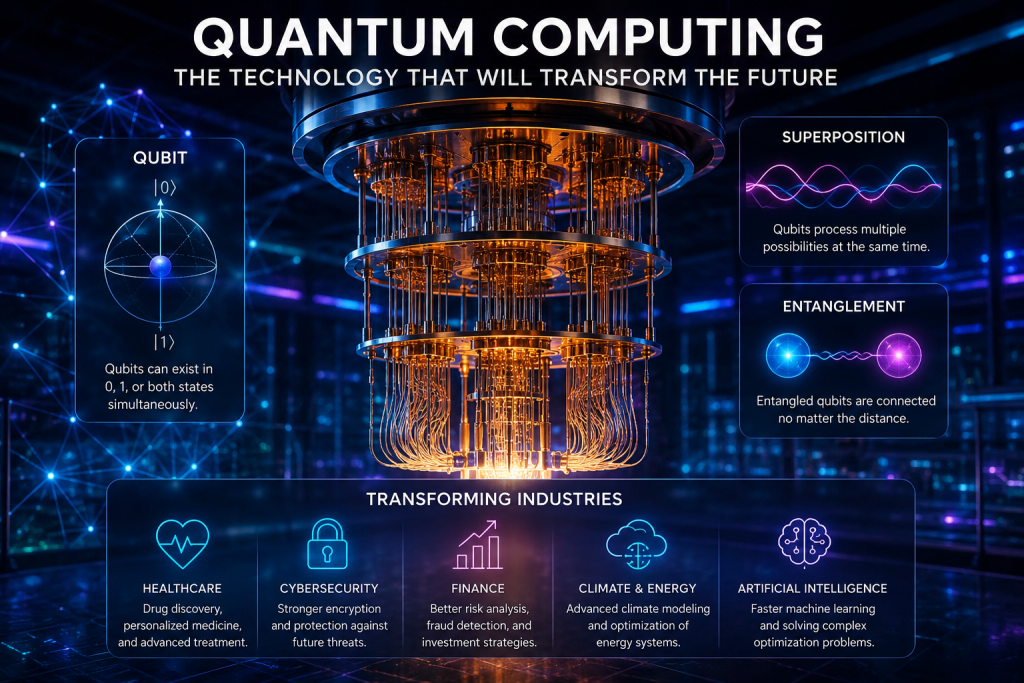
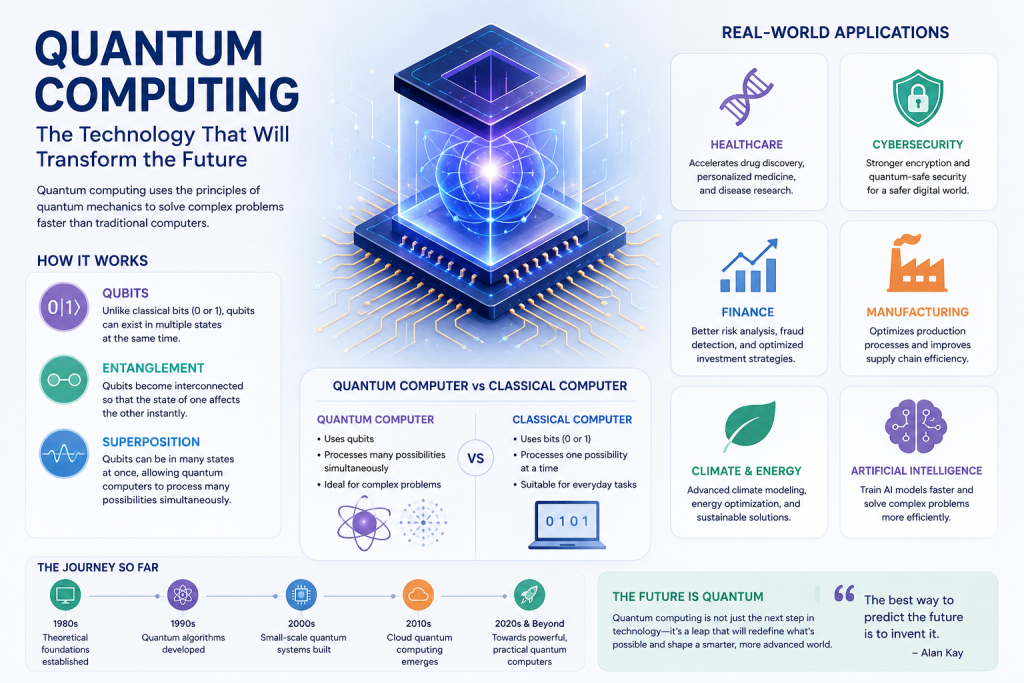
Unlike traditional computers, which process information using bits that can only be 0 or 1, quantum computers use quantum bits, also known as qubits.
This difference allows quantum computers to process enormous amounts of information simultaneously, making them capable of solving certain problems much faster than even today’s most advanced supercomputers.
Instead of checking one possibility after another, quantum computers can evaluate multiple possibilities at the same time. This unique ability could dramatically reduce the time required to solve highly complex calculations.
Quantum Computing vs. Classical Computing
To understand why quantum computing technology is revolutionary, it’s important to compare it with the computers we use every day.
Classical Computers
Traditional computers operate using binary bits.
Each bit has only two possible values:
- 0
- 1
Every application you use—from web browsers to video games—relies on billions of these binary calculations performed every second.
Classical computers are excellent for everyday tasks such as:
- Browsing the internet
- Watching videos
- Editing documents
- Programming
- Gaming
- Running business software
However, when faced with extremely complicated scientific simulations or optimization problems, even the fastest supercomputers may require years to find a solution.
Quantum Computers
Quantum computers work differently.
Instead of relying only on 0 or 1, qubits can exist in multiple states simultaneously due to the principles of quantum mechanics.
Because of this, quantum computing can analyze many possible solutions at once instead of processing them one by one.
This makes quantum computers especially powerful for solving problems involving:
- Drug discovery
- Climate modeling
- Financial forecasting
- Artificial intelligence
- Cryptography
- Complex logistics
Why Is Quantum Computing So Important?
Many of today’s biggest global challenges require enormous computing power.
Scientists need to simulate molecules, researchers analyze massive datasets, and businesses solve optimization problems involving millions of variables.
Traditional computers eventually reach performance limits.
This is where quantum computing becomes revolutionary.
Its ability to perform highly complex calculations more efficiently could help solve problems that are currently beyond the reach of modern computers.
As research continues, the benefits of quantum computing are expected to expand into healthcare, finance, transportation, manufacturing, energy, and scientific research.
The Science Behind Quantum Computing
The power of quantum computers comes from several unique properties of quantum mechanics.
Superposition
Unlike ordinary bits, which are either 0 or 1, qubits can exist in multiple states simultaneously.
This allows quantum computers to explore many possible solutions at the same time rather than testing them individually.
Entanglement
Quantum particles can become connected in a phenomenon called entanglement.
When qubits are entangled, changes to one qubit can instantly influence another, allowing quantum systems to work together in highly efficient ways.
Quantum Interference
Quantum interference helps amplify correct solutions while reducing incorrect ones during calculations.
This improves the efficiency of quantum algorithms for specific types of problems.
Together, these principles make quantum computing technology fundamentally different from classical computing and explain why it has the potential to transform the future of technology.
Real-World Applications of Quantum Computing
Although quantum computing is still in its early stages, it is already showing incredible potential across many industries. Researchers, governments, and leading technology companies are investing billions of dollars to unlock its full capabilities.
As the technology matures, the future of quantum computing is expected to transform how businesses operate, how scientists conduct research, and how society solves some of its biggest challenges.
1. Revolutionizing Healthcare and Medicine
One of the most promising quantum computing applications is in healthcare.
Developing a new medicine often takes years because scientists must analyze millions of molecular combinations. Traditional computers struggle to simulate these complex interactions accurately.
Quantum computers could dramatically speed up this process by modeling molecules at the atomic level.
This could help researchers:
- Discover new medicines faster.
- Develop personalized treatments.
- Improve cancer research.
- Predict how drugs interact with the human body.
- Reduce the cost of pharmaceutical research.
With faster medical discoveries, millions of lives could benefit from more effective treatments and improved healthcare.
2. Strengthening Artificial Intelligence
Artificial intelligence (AI) relies on processing enormous amounts of data.
As datasets continue growing, traditional computers require more time and energy to train advanced AI models.
By combining quantum computing and AI, researchers hope to create systems capable of learning faster, solving complex optimization problems, and making more accurate predictions.
Potential improvements include:
- Faster machine learning.
- Better natural language processing.
- More accurate recommendation systems.
- Smarter autonomous vehicles.
- Improved robotics.
The combination of AI and quantum technology could drive innovations that are currently beyond today’s computing capabilities.
3. Transforming Cybersecurity
Cybersecurity is another field that will be greatly affected by quantum computing technology.
Modern encryption protects online banking, emails, digital payments, and sensitive government information.
Powerful quantum computers could eventually solve certain mathematical problems much faster than classical computers, making some current encryption methods less secure.
At the same time, researchers are developing quantum-safe encryption to protect data from future quantum attacks.
This means quantum computing in cybersecurity will create both challenges and new opportunities for stronger digital security.
4. Improving Financial Services
Banks and financial institutions analyze enormous amounts of information every second.
Quantum computers could help them:
- Detect financial fraud more quickly.
- Improve investment strategies.
- Predict market trends.
- Optimize trading decisions.
- Manage financial risks more accurately.
These improvements could make financial systems faster, more efficient, and better prepared for changing economic conditions.
5. Solving Climate and Environmental Challenges
Climate change is one of the world’s most complex scientific problems.
Researchers must analyze huge amounts of environmental data to understand weather patterns, carbon emissions, and energy systems.
The benefits of quantum computing could include:
- More accurate climate models.
- Better weather forecasting.
- Improved renewable energy research.
- Smarter power grid management.
- Faster development of sustainable materials.
By processing massive datasets more efficiently, quantum computers could support global efforts to protect the environment.
Which Industries Will Benefit the Most?
The impact of quantum computing will extend far beyond science laboratories.
Industries expected to benefit include:
- Healthcare
- Artificial Intelligence
- Cybersecurity
- Banking and Finance
- Manufacturing
- Transportation
- Logistics
- Aerospace
- Energy
- Telecommunications
- Scientific Research
- Government and Defense
As research continues, experts believe these industries will experience significant improvements in speed, accuracy, and innovation.
Why Are Companies Investing Billions in Quantum Computing?
The race to develop practical quantum computers has become one of the biggest technology competitions in history.
Leading technology companies and research organizations are investing billions because they believe quantum computing could become as revolutionary as the internet, smartphones, or artificial intelligence.
Organizations hope to gain advantages such as:
- Faster scientific discoveries.
- Better business optimization.
- Improved cybersecurity.
- More efficient manufacturing.
- Breakthrough innovations in medicine.
- Advanced AI capabilities.
These investments show that the future of quantum computing is not just a scientific dream—it is rapidly becoming an important part of tomorrow’s technology landscape.
Challenges and Limitations of Quantum Computing
While quantum computing has the potential to revolutionize technology, it is important to understand that the technology is still in its early stages. Building reliable quantum computers is one of the most difficult scientific and engineering challenges ever attempted.
Before quantum computers become part of everyday life, researchers must overcome several major obstacles.
1. Quantum Computers Are Extremely Sensitive
One of the biggest challenges in quantum computing technology is that qubits are incredibly fragile.
Tiny changes in their environment—such as heat, electromagnetic waves, or vibrations—can disrupt calculations. This problem is known as quantum decoherence.
To reduce errors, quantum computers often operate at temperatures colder than outer space, using highly specialized cooling systems.
Because of these strict requirements, today’s quantum computers are expensive and difficult to maintain.
2. High Development Costs
Building a quantum computer requires advanced laboratories, specialized equipment, and years of research.
Governments and major technology companies have invested billions of dollars into quantum research, but developing stable and scalable quantum systems remains costly.
As the technology improves, experts expect costs to decrease, making quantum computing more accessible to businesses and research institutions.
3. Error Correction Is a Major Challenge
Unlike traditional computers, quantum computers are more likely to produce errors because qubits are highly sensitive.
Researchers are developing advanced quantum error correction techniques to improve reliability, but creating fault-tolerant quantum computers remains one of the biggest goals in the field.
Until this challenge is solved, large-scale commercial quantum computing applications will remain limited.
4. Limited Availability
Today, only a small number of organizations have access to powerful quantum computers.
Most researchers and developers use cloud-based quantum computing platforms to experiment with quantum algorithms.
Although access is improving, quantum computers are not yet practical for everyday consumers or small businesses.
Quantum Computing vs. Artificial Intelligence
Many people believe that quantum computing and AI are the same technology, but they serve different purposes.
Artificial intelligence focuses on enabling machines to learn from data, recognize patterns, and make decisions.
Quantum computing focuses on solving certain complex mathematical problems much faster than classical computers.
When combined, however, these two technologies could create powerful new solutions.
For example:
- AI models could train faster.
- Scientific simulations could become more accurate.
- Large datasets could be analyzed more efficiently.
- Medical research could accelerate.
- Complex optimization problems could be solved in less time.
Rather than replacing AI, quantum computing is expected to enhance its capabilities.
Will Quantum Computers Replace Traditional Computers?
The simple answer is no.
Although quantum computing is incredibly powerful, it is not designed to replace laptops, smartphones, or desktop computers.
Traditional computers will continue handling everyday tasks such as:
- Browsing the internet
- Watching videos
- Sending emails
- Playing games
- Writing documents
- Software development
Quantum computers are designed for specialized problems that require enormous computational power.
Instead of replacing classical computers, both technologies will likely work together, with each being used where it performs best.
The Future of Quantum Computing
Experts believe the future of quantum computing will develop gradually over the next decade.
As hardware improves and researchers solve current technical challenges, quantum computers are expected to become more reliable and practical.
Future developments may include:
- Faster drug discovery.
- More accurate weather forecasting.
- Advanced artificial intelligence systems.
- Smarter transportation networks.
- Stronger cybersecurity solutions.
- Improved financial modeling.
- More efficient supply chain management.
- Breakthrough scientific discoveries.
Although it may take years before quantum computers become widely available, their long-term impact could be as transformative as the invention of the internet.
Businesses, governments, and researchers around the world are preparing for this technological revolution because they recognize that quantum computing has the potential to reshape industries and solve problems that were once considered impossible.
Frequently Asked Questions About Quantum Computing
As quantum computing becomes more popular, many people have questions about how it works and what it means for the future. Here are answers to some of the most common questions.
1. When Will Quantum Computers Become Common?
Quantum computers are already being used in research laboratories and by major technology companies, but they are not yet ready for everyday consumer use.
Experts predict that practical quantum computing technology will continue to improve throughout the next decade. As hardware becomes more stable and affordable, businesses in healthcare, finance, manufacturing, and cybersecurity are expected to adopt quantum solutions more widely.
2. Will Quantum Computing Replace Artificial Intelligence?
No. Artificial intelligence and quantum computing serve different purposes.
Artificial intelligence focuses on enabling computers to learn from data and make intelligent decisions, while quantum computing is designed to solve highly complex calculations much faster than traditional computers.
In the future, quantum computing and AI are likely to work together, allowing AI systems to process larger datasets, train models faster, and solve more advanced problems.
3. Is Quantum Computing Safe?
Like every powerful technology, quantum computing has both benefits and risks.
On the positive side, it could help create better medicines, improve scientific research, optimize transportation systems, and accelerate technological innovation.
However, quantum computers may eventually be capable of breaking some of today’s encryption methods. This is why researchers are developing new quantum-resistant encryption techniques to protect sensitive information.
Responsible development and international cooperation will play a key role in ensuring that quantum technology is used safely and ethically.
4. Which Companies Are Leading Quantum Computing?
Several of the world’s largest technology companies are investing heavily in quantum computing technology.
Some of the leading organizations include:
- IBM
- Microsoft
- Intel
- Amazon
- NVIDIA
- IonQ
- Rigetti Computing
- D-Wave Systems
These companies are developing quantum hardware, software, cloud platforms, and research tools that will shape the future of computing.
5. Can Students Learn Quantum Computing?
Absolutely.
Although quantum mechanics involves advanced concepts, many universities and online learning platforms now offer beginner-friendly courses on quantum computing.
Students interested in this field should build a strong foundation in:
- Mathematics
- Physics
- Computer Science
- Programming (especially Python)
- Linear Algebra
- Probability
As demand for quantum professionals grows, learning these skills today could open exciting career opportunities in the future.
Conclusion
Quantum computing is no longer just a futuristic concept—it is rapidly becoming one of the most transformative technologies of our time. By harnessing the principles of quantum mechanics, quantum computers have the potential to solve problems that are beyond the capabilities of even the fastest classical supercomputers.
The future of quantum computing promises breakthroughs in healthcare, cybersecurity, artificial intelligence, finance, environmental science, and countless other industries. While technical challenges such as error correction, hardware stability, and high development costs remain, researchers continue to make remarkable progress every year.
As governments, universities, and technology companies invest billions of dollars into quantum research, the pace of innovation is accelerating. In the coming years, quantum computing applications are expected to become more practical, helping solve real-world challenges faster and more efficiently.
Although traditional computers will remain essential for everyday tasks, quantum computers will complement them by tackling highly complex problems that were previously impossible to solve.
The future belongs to technologies that push the boundaries of innovation, and quantum computing is leading that transformation. Understanding this revolutionary technology today will help individuals, businesses, and future generations prepare for a world where computing power reaches entirely new levels.
Whether you are a student, technology enthusiast, researcher, or business professional, keeping an eye on quantum computing is more important than ever. The next technological revolution has already begun, and quantum computing is at the center of it.