
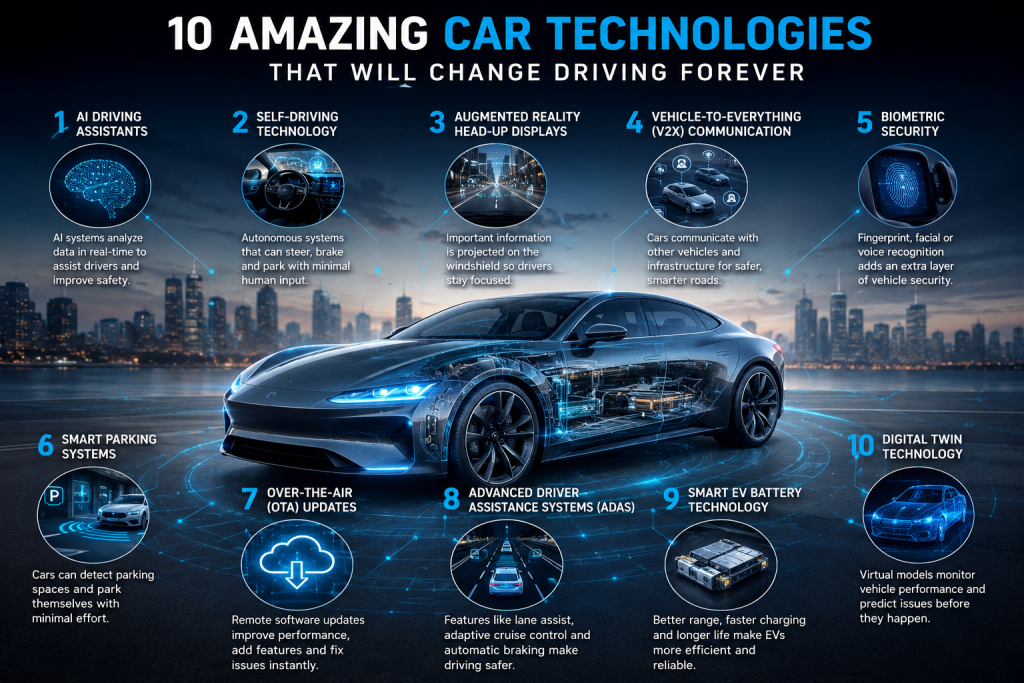
Cars have come a long way from being simple machines that take us from one place to another. Today, they are becoming smarter, safer, and more connected than ever before. Thanks to rapid advancements in future car technologies, modern vehicles are equipped with intelligent systems that improve safety, comfort, and the overall driving experience. From artificial intelligence to self-driving capabilities, the automotive industry is entering a new era of innovation.
In this article, we’ll explore 10 amazing car technologies that are transforming the future of driving and changing the way we interact with our vehicles.
1. Artificial Intelligence (AI) Driving Assistants
Artificial intelligence is revolutionizing the automotive world. AI-powered systems can monitor road conditions, analyze driver behavior, provide navigation suggestions, and even warn drivers before an accident occurs. Many modern vehicles now feature voice assistants that allow drivers to control music, navigation, and climate settings without taking their hands off the steering wheel.
2. Self-Driving Technology
Autonomous driving is no longer just a futuristic dream. Many automakers are developing self-driving systems that can steer, accelerate, brake, and park with minimal human input. While fully autonomous cars are still evolving, advanced driver assistance systems (ADAS) are already making driving safer by reducing human error.
3. Augmented Reality Head-Up Displays (AR HUD)
Instead of looking down at the dashboard, drivers can now see important information projected directly onto the windshield. Augmented reality displays show navigation directions, speed limits, and hazard warnings, allowing drivers to stay focused on the road while accessing essential information.
4. Vehicle-to-Everything (V2X) Communication
Connected cars can communicate with other vehicles, traffic lights, and road infrastructure through Vehicle-to-Everything (V2X) technology. This real-time communication helps reduce traffic congestion, improves road safety, and warns drivers about accidents or dangerous road conditions before they reach them.
5. Biometric Vehicle Security
Traditional car keys are gradually being replaced by biometric authentication. Modern vehicles can use fingerprint scanners, facial recognition, or even voice recognition to unlock doors and start the engine. This technology improves security and reduces the risk of vehicle theft.
6. Smart Parking Systems
Parking in crowded areas can be stressful, but smart parking technology makes it much easier. Many vehicles can automatically detect parking spaces and park themselves with minimal driver assistance. Some advanced models can even be parked remotely using a smartphone app.
7. Over-the-Air (OTA) Software Updates
Just like smartphones receive software updates, modern vehicles can now improve through Over-the-Air (OTA) updates. Automakers can remotely add new features, fix software bugs, enhance vehicle performance, and strengthen cybersecurity without requiring drivers to visit a service center. This technology keeps cars up to date and extends their lifespan.
8. Advanced Driver Assistance Systems (ADAS)
Advanced Driver Assistance Systems, commonly known as ADAS, are making roads much safer. These intelligent features include adaptive cruise control, lane-keeping assist, automatic emergency braking, blind-spot monitoring, and traffic sign recognition. By helping drivers avoid collisions and maintain better control, ADAS is reducing accidents caused by human error.
9. Smart Electric Vehicle Battery Technology
Electric vehicles are becoming more practical thanks to rapid improvements in battery technology. Modern batteries offer longer driving ranges, faster charging times, and greater durability. Researchers are also developing solid-state batteries, which promise higher energy density, improved safety, and shorter charging times. These innovations are making electric vehicles a more attractive choice for drivers around the world.
10. Digital Twin Technology
One of the most exciting future car technologies is Digital Twin Technology. A digital twin is a virtual copy of a real vehicle that continuously receives data from sensors. Manufacturers use this digital model to monitor vehicle performance, predict maintenance needs, test software updates, and identify potential problems before they occur. This technology improves reliability while reducing repair costs and downtime.
The Future of Driving Is Smarter Than Ever
The automotive industry is evolving faster than ever before. Technologies such as AI in cars, self-driving systems, connected cars, and smart vehicle features are transforming the way people travel. In the coming years, vehicles will become even more intelligent, environmentally friendly, and capable of communicating with everything around them.
Whether it’s preventing accidents, improving fuel efficiency, or providing a more comfortable driving experience, these innovations are shaping the future of transportation. As future car technologies continue to advance, driving will become safer, smarter, and more enjoyable for everyone.
Frequently Asked Questions (FAQs)
1. What are future car technologies?
Future car technologies are advanced innovations designed to make vehicles safer, smarter, more efficient, and more environmentally friendly. They include AI-powered driving assistants, self-driving systems, connected cars, smart batteries, biometric security, and augmented reality displays.
2. What is the most important technology in modern cars?
Artificial Intelligence (AI) is considered one of the most important technologies in modern vehicles. AI helps power advanced safety features, voice assistants, predictive maintenance, intelligent navigation, and autonomous driving systems.
3. Are self-driving cars completely safe?
Self-driving technology has improved significantly, but fully autonomous vehicles are still being developed and tested. Most cars currently use Advanced Driver Assistance Systems (ADAS), which support drivers but still require human supervision.
4. How do connected cars work?
Connected cars use internet connectivity and Vehicle-to-Everything (V2X) communication to exchange data with other vehicles, traffic signals, navigation systems, and cloud services. This helps improve traffic flow, safety, and the overall driving experience.
5. Why are electric vehicles considered the future?
Electric vehicles produce fewer emissions, require less maintenance, and benefit from rapidly improving battery technology. As charging infrastructure expands and battery performance improves, EVs are expected to play a major role in the future of transportation.
Final Thoughts
The automotive industry is entering an exciting new era driven by innovation. From AI in cars and self-driving technology to connected vehicles and smart battery systems, these advancements are redefining what it means to drive. What once seemed like science fiction is quickly becoming part of everyday life.
As these future car technologies continue to evolve, drivers can expect safer roads, greater convenience, lower environmental impact, and more personalized driving experiences. Whether you’re a car enthusiast or simply curious about the future, keeping up with these innovations will help you understand where transportation is headed next.
If the current pace of innovation continues, the cars of tomorrow won’t just take us to our destinations—they’ll think, learn, communicate, and help make every journey safer and smarter.