
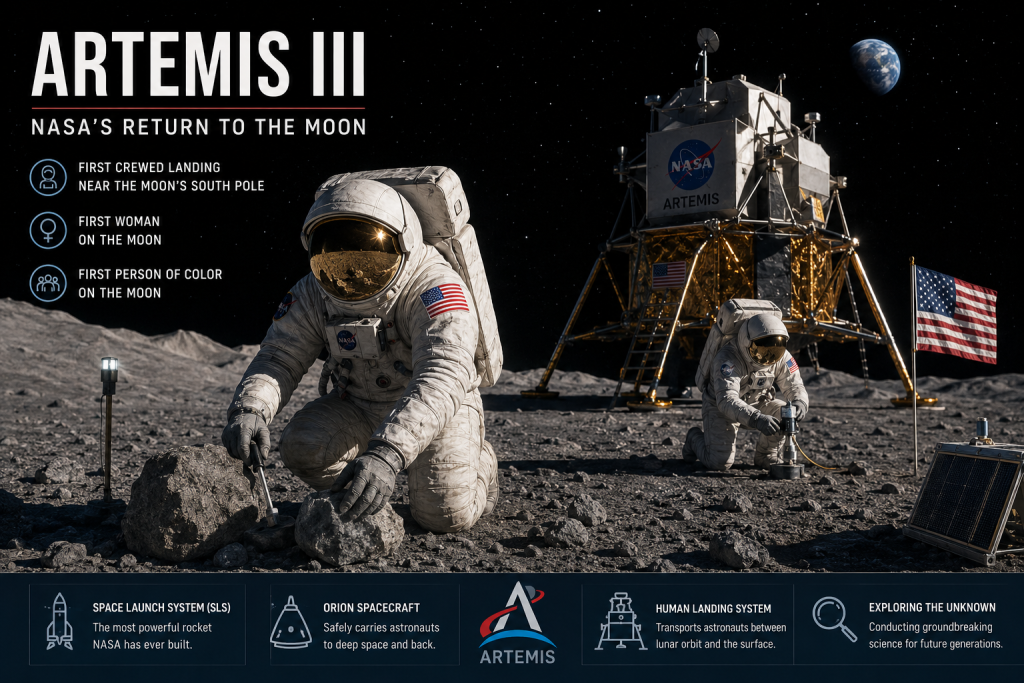
For more than 50 years, humans have dreamed of returning to the Moon. After the historic Apollo missions ended in the 1970s, crewed lunar exploration came to a halt. Now, NASA is preparing to make history once again with the Artemis III Mission, a groundbreaking project that aims to land astronauts near the Moon’s south pole and pave the way for future missions to Mars.
The Artemis program is more than just another Moon mission. It represents a new era of space exploration, bringing together advanced technology, international partnerships, and scientific research. Unlike the Apollo missions, Artemis is designed to establish a long-term human presence on the Moon, allowing astronauts to live, work, and conduct experiments that could shape the future of space travel.
What Is the Artemis III Mission?
The Artemis III Mission is NASA’s first planned crewed lunar landing since Apollo 17 in 1972. The mission will send astronauts from Earth to lunar orbit aboard the Orion spacecraft, launched by NASA’s powerful Space Launch System (SLS) rocket. From lunar orbit, a specialized human landing system will transport two astronauts to the Moon’s surface while the remaining crew members stay aboard Orion.
One of the mission’s biggest goals is to land astronauts near the Moon’s south pole, a region that has never been explored by humans. Scientists believe this area contains water ice trapped inside permanently shadowed craters. If confirmed, these resources could provide drinking water, oxygen, and even rocket fuel for future deep-space missions.
Why Is the Moon’s South Pole So Important?
The Moon’s south pole has become one of the most exciting destinations in space exploration. Unlike the regions visited during the Apollo era, the south pole offers unique scientific opportunities.
Researchers believe that water ice has remained frozen there for billions of years. Studying these icy deposits could reveal valuable information about the Moon’s history and the origins of water in our solar system. More importantly, these resources may help astronauts survive during long-term missions without depending entirely on supplies from Earth.
The region also experiences long periods of sunlight on nearby peaks, making it an ideal location for solar-powered equipment and future lunar bases. This combination of natural resources and favorable conditions makes the south pole a key target for NASA’s future exploration plans.
How Artemis III Differs from Apollo
Although both programs share the goal of landing humans on the Moon, the Artemis III Mission is far more advanced than the Apollo missions.
Modern spacecraft feature cutting-edge navigation systems, improved life-support technology, advanced communications, and more powerful computing capabilities. NASA is also working with commercial partners to develop innovative lunar landing systems and technologies that can support repeated missions rather than a single visit.
Another historic milestone is that Artemis III is expected to include the first woman and the first person of color to walk on the Moon, reflecting NASA’s commitment to expanding opportunities in human space exploration.
The mission is not simply about planting another flag on the lunar surface. Instead, it aims to create the foundation for sustainable exploration that will eventually support human missions to Mars and beyond.
The Technology Powering the Artemis III Mission
The Artemis III Mission relies on some of the most advanced space technologies ever developed. Every component of the mission has been designed to support safer, longer, and more efficient human exploration beyond Earth.
Space Launch System (SLS)
NASA’s Space Launch System (SLS) is the most powerful rocket the agency has ever built. It is designed to carry astronauts, scientific equipment, and cargo beyond low Earth orbit. During Artemis III, the SLS will launch the Orion spacecraft and its crew on their journey to the Moon.
Orion Spacecraft
The Orion spacecraft serves as the astronauts’ home during their mission. It is equipped with advanced navigation systems, radiation protection, life-support technology, and emergency safety features. Orion can safely transport astronauts farther into space than any previous NASA crew vehicle.
Human Landing System (HLS)
After reaching lunar orbit, two astronauts will transfer to the Human Landing System (HLS), which is being developed to transport them safely to the Moon’s surface and back to Orion. This spacecraft is specifically designed for lunar exploration and future deep-space missions.
Lunar Exploration Equipment
Astronauts will carry advanced scientific instruments to study the Moon’s geology, search for water ice, collect rock samples, and analyze the lunar environment. The mission will also test new technologies that could support future lunar habitats and long-term human exploration.
Scientific Goals of Artemis III
The Artemis III Mission is not just about returning astronauts to the Moon—it is a major scientific expedition with several important objectives.
Some of the mission’s key goals include:
- Studying the Moon’s south pole in greater detail.
- Searching for and analyzing water ice deposits.
- Collecting new lunar rock and soil samples.
- Testing advanced technologies for future Moon bases.
- Learning how humans can survive during long-duration space missions.
- Preparing for future crewed missions to Mars.
Scientists believe these discoveries will improve our understanding of the Moon’s history while helping engineers develop technologies needed for deep-space exploration.
Why Artemis III Matters for the Future of Space Exploration
The success of the Artemis III Mission could reshape the future of human space travel. Instead of visiting the Moon once and leaving, NASA hopes to establish a sustainable presence through future Artemis missions.
The knowledge gained from living and working on the Moon will help astronauts prepare for the much longer journey to Mars. Engineers will also learn how to produce resources directly on the Moon, reducing the need to transport everything from Earth.
In many ways, Artemis III represents the first major step toward humanity becoming a multi-planetary civilization. The technologies, scientific discoveries, and international cooperation developed through this mission may influence space exploration for decades to come.
Challenges Facing the Artemis III Mission
Although the Artemis III Mission is one of NASA’s most ambitious projects, it also faces several technical and operational challenges.
One of the biggest challenges is ensuring that every spacecraft and system works perfectly together. The mission depends on the successful performance of the Space Launch System (SLS), the Orion spacecraft, the Human Landing System (HLS), and advanced spacesuits designed specifically for lunar exploration.
Another challenge is the harsh environment of the Moon’s south pole. Temperatures can vary dramatically, and some craters remain in permanent darkness, making exploration more difficult. NASA engineers are developing new technologies to help astronauts safely operate under these extreme conditions.
Despite these obstacles, NASA continues to conduct extensive testing and preparation to maximize the mission’s chances of success.
Global Partnerships Behind Artemis III
The Artemis program is not solely a NASA effort. It is supported by numerous international space agencies and commercial partners working together to achieve a common goal.
Agencies such as the European Space Agency (ESA), the Japan Aerospace Exploration Agency (JAXA), and the Canadian Space Agency (CSA) are contributing technology, scientific instruments, and mission support. Commercial aerospace companies are also playing an important role in developing spacecraft, landing systems, and future lunar infrastructure.
This international cooperation demonstrates how space exploration has become a global effort, with countries sharing knowledge and resources to expand humanity’s presence beyond Earth.
What Happens After Artemis III?
The Artemis III Mission is only the beginning of NASA’s long-term exploration strategy.
Future Artemis missions are expected to:
- Build a sustainable human presence on the Moon.
- Develop the Lunar Gateway, a space station that will orbit the Moon.
- Test technologies needed for deep-space exploration.
- Expand scientific research on the lunar surface.
- Prepare astronauts for future crewed missions to Mars.
NASA hopes that the lessons learned from Artemis III will make future missions safer, more efficient, and capable of supporting long-duration exploration.
Final Thoughts
The Artemis III Mission represents one of the most significant milestones in modern space exploration. More than half a century after the last Apollo mission, humanity is preparing to return to the Moon with better technology, greater scientific knowledge, and a vision that extends far beyond lunar exploration.
If successful, Artemis III will not only mark the first human landing on the Moon in over 50 years but also lay the foundation for permanent lunar exploration and future journeys to Mars. As the mission progresses, millions of people around the world will be watching, knowing that this historic achievement could shape the future of space travel for generations.
Frequently Asked Questions (FAQs)
1. What is the Artemis III Mission?
The Artemis III Mission is NASA’s planned mission to land astronauts near the Moon’s south pole, marking the first crewed lunar landing since Apollo 17 in 1972.
2. Why is the Moon’s south pole important?
Scientists believe it contains water ice that could provide drinking water, oxygen, and fuel for future missions while offering valuable scientific insights into the Moon’s history.
3. Who will participate in Artemis III?
NASA plans to send four astronauts. Two are expected to land on the Moon while the other two remain in lunar orbit aboard the Orion spacecraft.
4. How will Artemis III help future Mars missions?
The mission will test technologies, equipment, and survival methods needed for long-duration human exploration, providing valuable experience for future missions to Mars.
References
To learn more about the Artemis III Mission and NASA’s plans for future space exploration, you can visit these official resources:
- NASA Artemis Program – https://www.nasa.gov/artemis/
- NASA Moon to Mars – https://www.nasa.gov/moon-to-mars/
- NASA Orion Spacecraft – https://www.nasa.gov/orion/
- NASA Space Launch System (SLS) – https://www.nasa.gov/exploration/systems/sls/
Key Takeaways
If you only remember a few things about the Artemis III Mission, these are the most important:
- Artemis III will be NASA’s first crewed Moon landing since 1972.
- The mission aims to land astronauts near the Moon’s south pole.
- Scientists hope to study water ice that could support future lunar bases.
- NASA will use the powerful Space Launch System (SLS), the Orion spacecraft, and a Human Landing System for the mission.
- Artemis III is expected to include the first woman and the first person of color to walk on the Moon.
- The mission is designed to prepare humanity for long-term exploration of the Moon and future crewed missions to Mars.
- International partners and private companies are playing an important role in making the mission possible.
Conclusion
The Artemis III Mission is more than a return to the Moon—it’s the beginning of a new chapter in human space exploration. By combining advanced technology, international collaboration, and ambitious scientific goals, NASA is laying the groundwork for a future where humans can live and work beyond Earth.
The discoveries made during Artemis III could reshape our understanding of the Moon, unlock new opportunities for scientific research, and help solve the challenges of sending astronauts to Mars. As the countdown to launch continues, the mission stands as a powerful reminder that space exploration continues to inspire innovation, cooperation, and curiosity around the world.
Whether you’re a space enthusiast, a student, or simply curious about humanity’s next giant leap, the Artemis III Mission is a story worth following. Its success could influence the future of exploration for decades and inspire a new generation to dream beyond the stars.
Frequently Asked Questions (FAQs)
1. What is the Artemis III Mission?
The Artemis III Mission is NASA’s planned mission to return astronauts to the Moon for the first time since Apollo 17 in 1972. It aims to land astronauts near the Moon’s south pole and advance scientific exploration.
2. When will Artemis III launch?
NASA is currently targeting the mid-2027 timeframe for Artemis III, although the exact launch date depends on testing, mission readiness, and the completion of all required spacecraft systems.
3. Why is NASA returning to the Moon?
NASA is returning to the Moon to conduct scientific research, explore the Moon’s south pole, search for water ice, test new technologies, and prepare astronauts for future missions to Mars.
4. Why is the Moon’s south pole important?
The Moon’s south pole is believed to contain frozen water ice inside permanently shadowed craters. This ice could provide drinking water, oxygen, and even rocket fuel for future lunar missions.
5. How many astronauts will fly on Artemis III?
NASA plans to send four astronauts aboard the Orion spacecraft. Two astronauts are expected to land on the Moon while the other two remain in lunar orbit.
6. What spacecraft will Artemis III use?
The mission will use NASA’s Space Launch System (SLS) rocket, the Orion spacecraft, and a Human Landing System (HLS) to transport astronauts safely to and from the Moon’s surface.
7. Will Artemis III include the first woman on the Moon?
Yes. NASA has stated that Artemis III is expected to land the first woman and the first person of color on the Moon, marking a historic milestone in space exploration.
8. How long will the Artemis III Mission last?
The exact mission duration will depend on the final mission plan, but it is expected to last around 10 to 30 days, including travel time and operations in lunar orbit and on the Moon’s surface.
9. How is Artemis different from the Apollo missions?
Unlike the Apollo missions, Artemis focuses on building a sustainable human presence on the Moon. It uses modern spacecraft, advanced technology, international partnerships, and aims to prepare for future missions to Mars.
10. How will Artemis III help future Mars missions?
The mission will test technologies, life-support systems, lunar operations, and resource utilization techniques that are essential for safely sending astronauts to Mars in the future.